Does Scientific Productivity Increase the Publication of Positive Results?
Our paper in Collabra: Psychology investigates whether German clinical psychology research groups with high versus low publication outputs differ in the prevalence of positive results. Analyzing 2,280 empirical studies from 99 research groups (2013–2022), we find approximately 90% positive results across the board, with no significant difference between high- and low-output groups. Scientific productivity does not differentially explain the excess of positive results.
| 📄 Paper (Collabra: Psychology) | 📝 Preregistration (OSF) | 💻 Code & Data (GitHub) |
Motivation: Does publish-or-perish drive positive results?
Positive results are common in the psychology literature: rates between 91–97% are consistently reported for hypothesis-testing studies
But previous work has measured pressure at the macro level (state-wide or discipline-wide). We asked: does publication pressure at the organizational (meso) level—specifically, the scientific productivity of a research group—predict higher rates of positive results?
Two mechanisms could link high productivity to more positive results. First, a social mechanism: groups under higher productivity expectations may face stronger pressure to produce publishable (i.e., positive) findings
Method: Mapping German clinical psychology output
Data collection
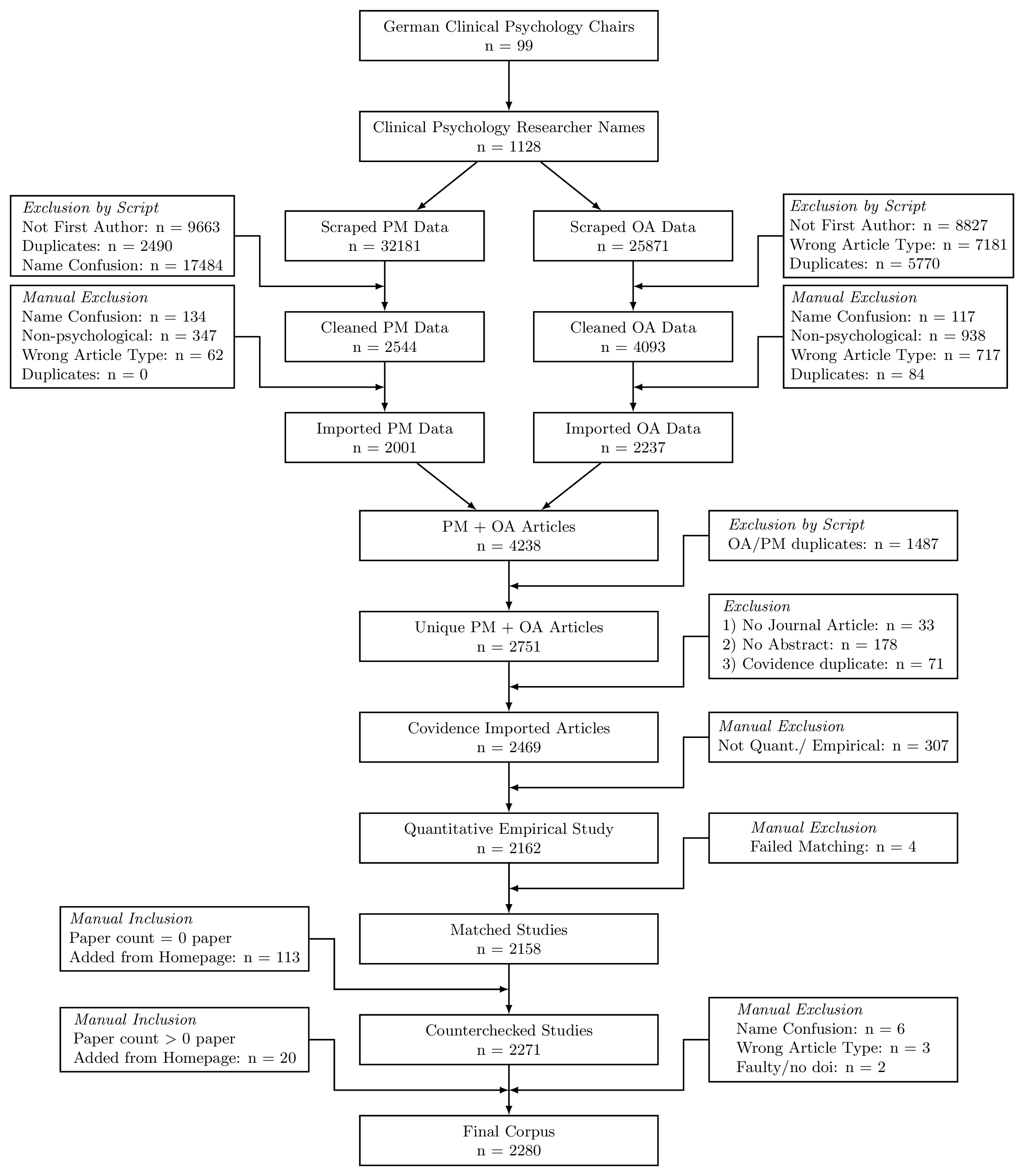
We conducted a comprehensive survey of all quantitative-empirical publications first-authored by clinical psychology researchers affiliated with German universities from 2013 to 2022. This involved:
- Identifying 99 research groups across 52 universities (all 16 German federal states)
- Compiling 1,128 researcher names from group websites
- Extracting metadata from PubMed and OpenAlex
- Extensive multi-step cleaning (removing name confusions, duplicates, non-empirical studies)
- Manual verification against institutional publication lists
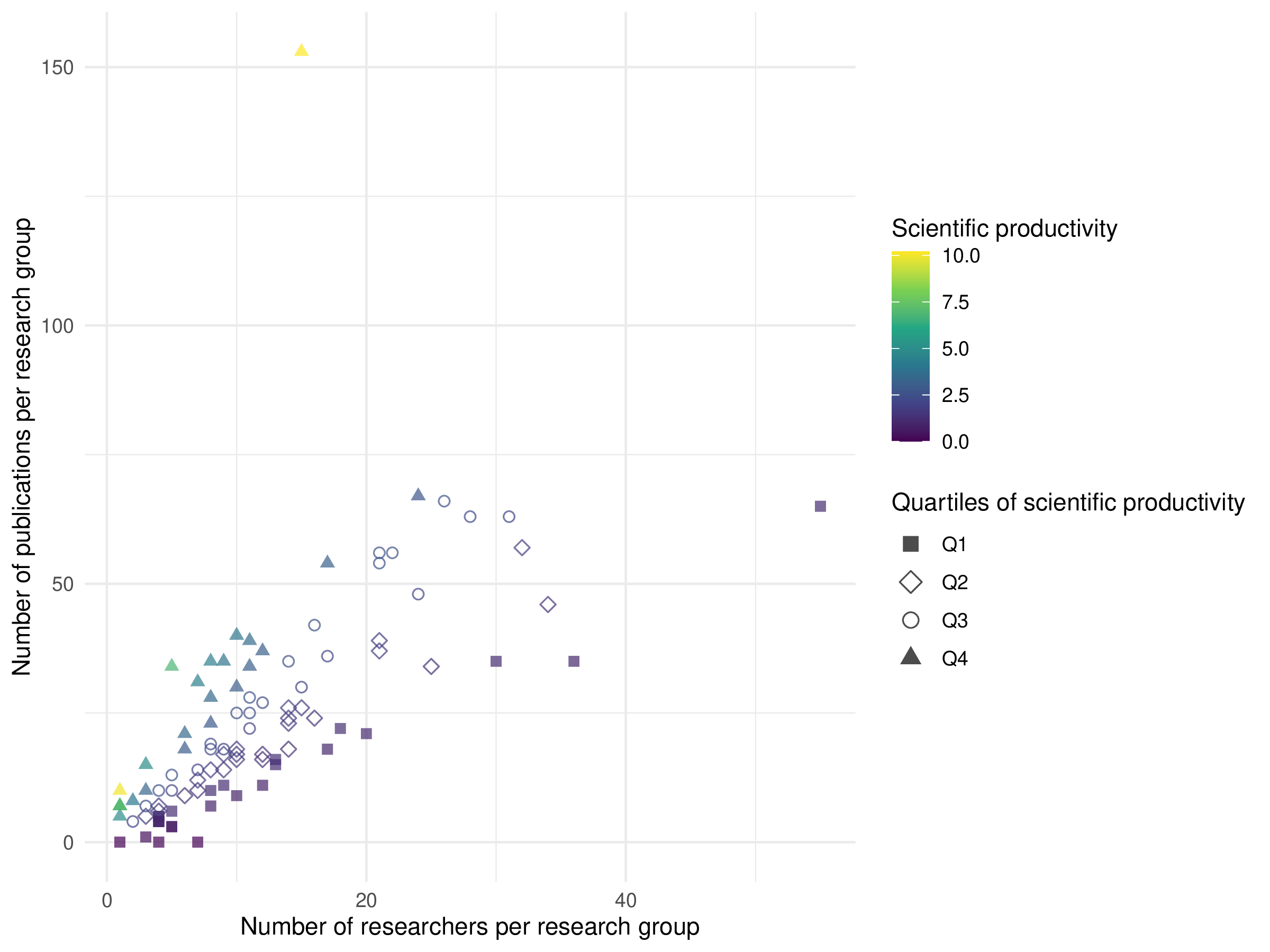
The final corpus comprised 2,280 empirical studies. Scientific productivity was defined as the ratio of quantitative-empirical publications to the number of academic staff per research group.
Annotation and analysis
We randomly sampled 300 papers (150 from the bottom quartile Q1 and 150 from the top quartile Q4 of scientific productivity) and annotated the result of the first reported hypothesis following the procedures of Fanelli and Scheel et al.
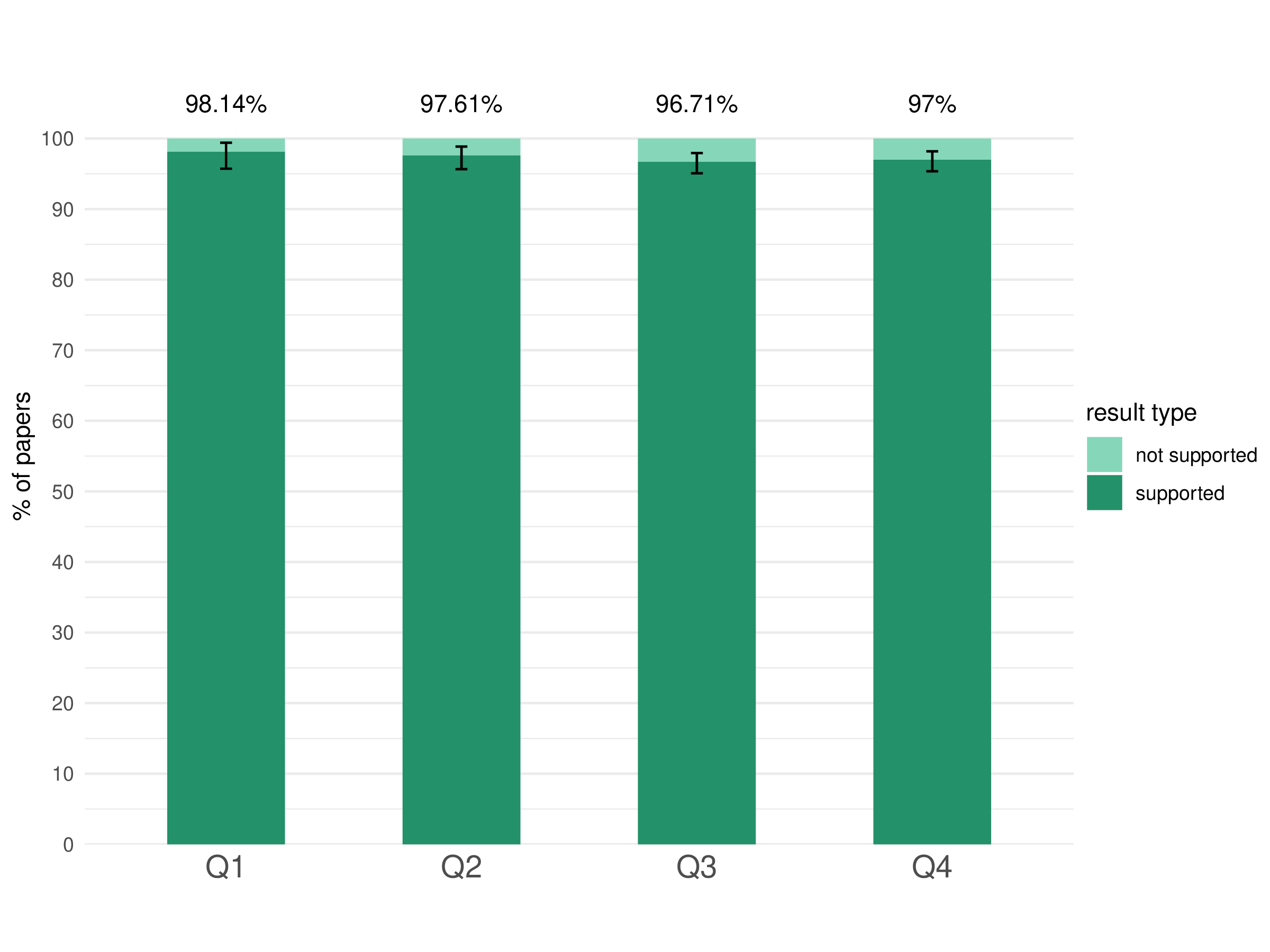
Additionally, we conducted exploratory abstract-level annotations on 1,990 studies across all four quartiles, classifying each abstract based on all reported results.
Results
No difference between high- and low-output groups
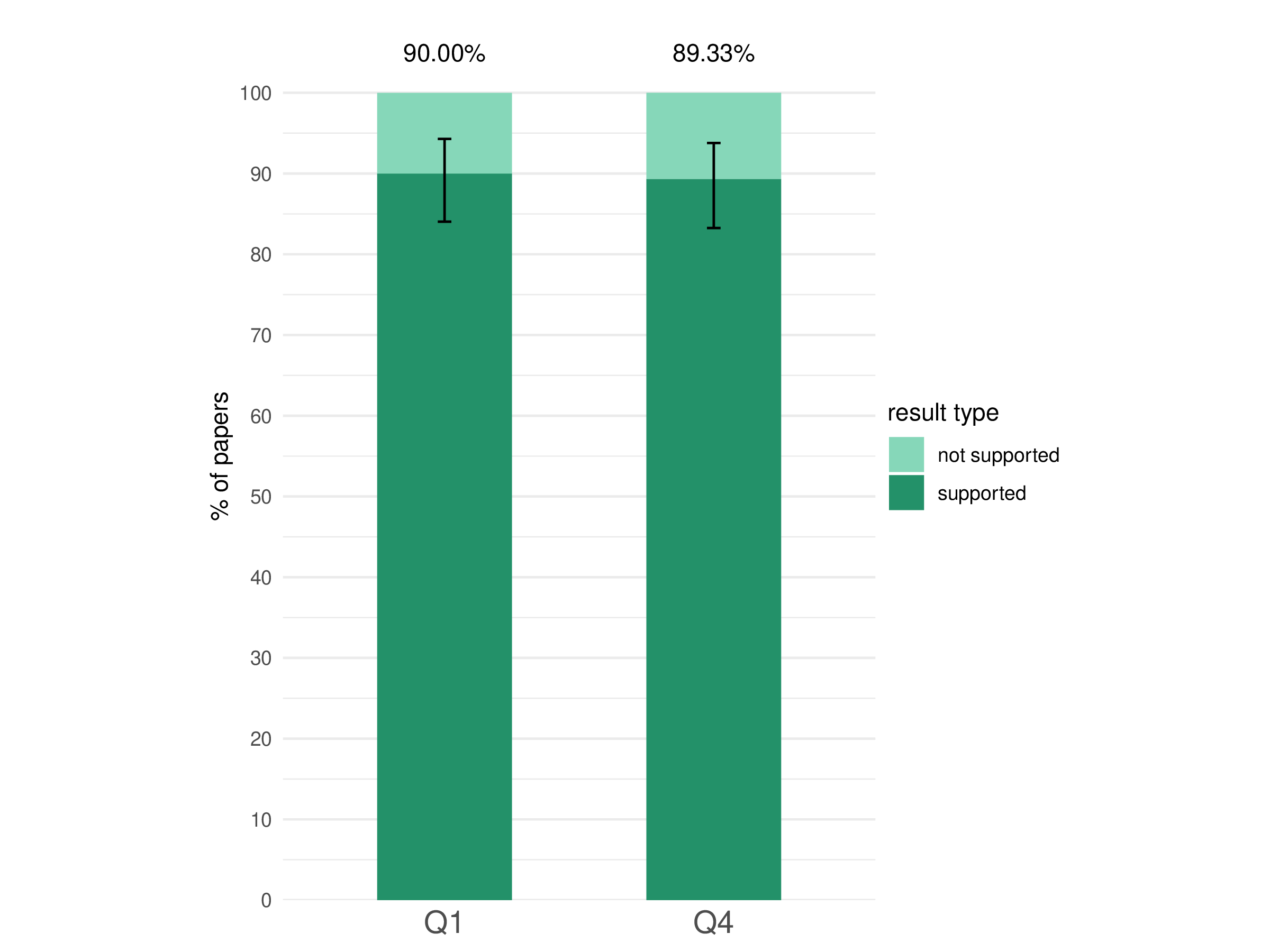
~90% of studies reported positive results, regardless of group productivity.
- Q1 (low output): 90.00% positive (95% CI: 84.0–94.3%)
- Q4 (high output): 89.33% positive (95% CI: 83.3–93.8%)
- Difference: $-0.67\%$, $p = .500$ (one-sided proportion test)
A logistic regression testing whether raw group paper count predicted positive results found no significant effect (OR = 1.00, $p = .356$).
Abstract-level analyses across all quartiles
When extending to abstract-level annotations across all four quartiles, 97.19% of 1,990 abstracts reported full or partial support. A chi-square test found no significant association between productivity quartile and support category ($\chi^2(6) = 6.67$, $p = .353$). Logistic regression with scientific productivity as a continuous predictor was likewise non-significant ($p = .432$).
An exploratory finding: bottom-quartile groups used the word “significant” more often when describing their first hypothesis results (38% vs. 27%, $p = .048$).
Discussion and implications
For metascience: We did not find evidence that scientific productivity at the research group level differentially explains the high rate of positive results. This contrasts with Fanelli’s
For clinical psychology: Approximately 9 in 10 studies supported their first hypothesis, with no difference by group productivity. Our observed rate of 89.67% is consistent with Fanelli
Implications: Since productivity differences do not appear to account for positive result rates, discussions about reforms—such as registered reports
If you find this work useful for your research, please consider citing our paper:
@article{schiekiera2025productivity,
  title={Does Scientific Productivity Increase the Publication
         of Positive Results?},
  author={Schiekiera, Louis and Niemeyer, Helen},
  journal={},
  year={2025}
}
📄 Read the paper here
📝 View the preregistration on OSF
💻 View the code and data on GitHub